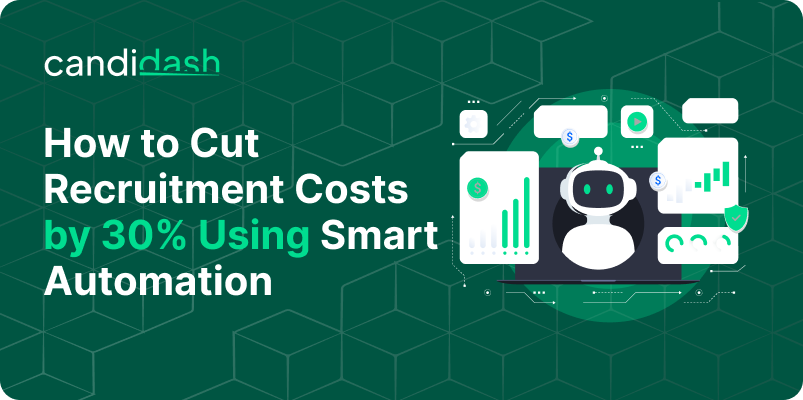
How to Cut Recruitment Costs by 30% Using Smart Automation
Recruitment is a cornerstone of any growing organization, yet it’s often one of the most expensive. Every stage, from sourcing and screening to interviewing and onboarding, demands significant time, manpower, and money. In today’s competitive talent market, where speed and efficiency dictate your ability to hire top talent, many businesses find themselves battling rising recruitment costs and slow hiring timelines.
But there’s good news: a quiet revolution is transforming how businesses attract, engage, and hire candidates. Smart automation isn’t just accelerating the recruitment process; it’s dramatically cutting associated costs. When used strategically, automation can eliminate redundant manual tasks, enhance the candidate experience, reduce reliance on expensive third-party agencies, and provide unparalleled visibility into your hiring metrics. All of these directly contribute to significant cost savings.
Are You Seeing the Early Warning Signs?
- Excessive time spent on manual tasks like resume screening or scheduling interviews?
- High agency fees due to a lack of internal capacity?
- Slow time-to-hire that’s causing you to lose out on top candidates?
- Limited insights into your recruitment spend and ROI?
Unlock Major Savings with Smart Automation
The good news is you can significantly reduce recruitment costs—by up to 30% or more—without sacrificing hiring quality. The key is smart automation. When implemented correctly, recruitment automation doesn’t just save time; it saves money across every stage: sourcing, screening, engagement, and onboarding.
In this post, we’ll show you exactly how to leverage smart tools and workflows to make your hiring process leaner, faster, and much more cost-effective.
Ready to upgrade your recruitment process?
Why Recruitment Costs Are So High
- Job board fees and paid listings
- Recruiter hours spent on admin tasks
- Delays in hiring = productivity loss
- Candidate drop-offs requiring re-hiring
- Manual screening and mis-hires
10 Ways to Cut Recruitment Costs Using Automation
Here’s the detailed content for the first point under the section:
1. Automate Resume Screening
Resume screening is one of the most time-consuming and resource-draining stages in the hiring process. Recruiters often spend up to 60% of their time manually scanning resumes to identify qualified candidates — a repetitive, high-effort task that adds little strategic value and is prone to human error or bias.
Enter AI-powered resume screening tools.
How it cuts costs:
- Reduces recruiter hours: Automating this step frees up your recruitment team to focus on high-impact activities like candidate engagement and employer branding.
- Speeds up time-to-hire: Faster screening means less time with open roles, which lowers the indirect costs of vacancies.
- Minimizes bad hires: Advanced screening tools improve the quality of shortlists, which leads to better interviews and more accurate final selections — reducing turnover costs.
Example in action:
- Hiretual (HireEZ) – for enriched resume insights and AI search
- CVViZ – tailored for Indian markets with keyword-based filtering
- Freshteam by Freshworks – includes integrated screening with ATS
2. Smart Candidate Matching
One of the biggest inefficiencies in recruitment lies in the mismatch between job requirements and candidate profiles. Traditional keyword-based matching often overlooks great candidates who may use different terms to describe their skills or experience. This results in poor-quality shortlists, longer hiring cycles, and increased costs in sourcing and re-advertising jobs.
Smart candidate matching uses AI algorithms and machine learning models to go far beyond keyword filtering. These systems analyze structured and unstructured data — resumes, social profiles, skill assessments, and even past hiring outcomes — to intelligently match candidates to job openings based on relevance, cultural fit, predicted performance, and intent.
- Reduces sourcing costs: With better matches early in the process, you reduce dependency on paid job boards, external recruiters, or resourcing teams.
- Increases recruiter productivity: Recruiters spend less time manually evaluating profiles and more time engaging top-fit candidates.
- Improves offer-to-joining ratios: Better matching leads to better-fit candidates who are more likely to accept and stay in the role, reducing the cost of backfilling and retraining.
Example in action:
An e-commerce company integrated AI matching into its ATS. Instead of reviewing 500+ resumes manually, recruiters received auto-ranked lists based on skill-job fit scores. This led to a 40% reduction in sourcing time, fewer mis-hires, and an annual cost saving of over ₹20 lakhs in recruiter hours and agency fees.
Recommended tools:
- Eightfold.ai – Talent Intelligence platform with deep-matching AI
- Zoho Recruit – Affordable ATS with smart matching for SMBs
- Param.ai – Indian-focused AI matching and sourcing tool
3. Auto-Generate Job Descriptions
AI-powered job description generators solve this by quickly creating tailored, optimized, and engaging job descriptions using role-specific inputs. These tools can adapt tone, structure, and content based on job function, industry, seniority, and even diversity requirements. They also ensure that your JDs are keyword-optimized for search engines and job boards, improving visibility and applicant quality.
- Saves recruiter and manager time: What used to take hours can now be done in minutes — no more starting from scratch.
- Reduces hiring delays: Faster job posting means quicker outreach and earlier pipeline building.
- Increases application relevance: Well-written JDs attract more qualified candidates, reducing the volume of irrelevant applications and unnecessary screening.
A SaaS startup using an AI-based job description tool reported saving over 120 hours per quarter in drafting and editing time. More importantly, they saw a 25% increase in qualified applicants, reducing their dependency on external hiring agencies and cutting advertising costs by 15%.
- Textio – Real-time augmented writing for inclusive, optimized job posts
- Jasper – AI content generator that can create custom JDs with minimal input
- Joblint – Ensures job ads are free from jargon, bias, and contradictions
Auto-generating job descriptions using AI not only saves time and effort but also improves your employer branding and applicant quality — all while contributing directly to faster, cheaper, and smarter hiring.
4. Automate Candidate Engagement
One of the most overlooked cost drains in recruitment is inefficient candidate communication. Delayed responses, lack of updates, and inconsistent messaging can drive qualified candidates away — forcing companies to reinitiate sourcing efforts, prolong hiring cycles, and inflate recruitment spend.
Automated candidate engagement tools solve this by maintaining timely, personalized, and consistent communication throughout the hiring journey. From instant application acknowledgments to interview reminders and feedback follow-ups, automation ensures that candidates feel informed, respected, and connected — without overloading your recruitment team.
- Reduces candidate drop-offs: Keeping candidates engaged minimizes ghosting and improves offer acceptance rates.
- Saves recruiter time: Automation replaces repetitive email and message tasks, freeing recruiters to focus on strategic interactions.
- Improves employer brand: A smooth, responsive experience enhances your reputation — lowering future hiring costs by attracting better talent organically.
- Application confirmation emails
- Interview reminders and calendar syncs
- Automated follow-ups and feedback messages
- Nurture campaigns for talent pools
- Beamery – Candidate relationship automation and talent CRM
- Sense – Candidate experience automation, especially for staffing firms
- Olivia by Paradox – Conversational AI for engagement and scheduling
Bottom line:
5. Interview Scheduling Automation
Automated interview scheduling tools eliminate this bottleneck by allowing candidates to self-select interview slots based on the real-time availability of interviewers. Many tools integrate with calendar systems (Google, Outlook, etc.) and offer intelligent rescheduling, time zone handling, and reminders — without any manual back-and-forth.
- Reduces administrative workload: No more juggling calendars manually — recruiters save hours per role.
- Accelerates hiring: Quick scheduling means faster interviews and faster decision-making.
- Prevents candidate drop-offs: Convenience and flexibility improve show-up rates and reduce lost candidates due to delays.
A fintech firm using automated scheduling reported saving 10+ recruiter hours per week, leading to faster interview loops and a 20% improvement in offer turnaround time. As a result, they filled roles 30% faster and reduced overall recruitment costs by ₹18 lakhs annually.
- Calendly – Widely used and integrates with ATS platforms
- GoodTime – Built specifically for recruitment coordination at scale
- HireVue Scheduler – Integrated with video interview platforms
Ready to upgrade your recruitment process?
6. Reuse Your Candidate Database
Recruiters often overlook one of their most valuable assets — their existing talent database. Instead of re-advertising roles or relying heavily on job portals and agencies, companies can drastically cut recruitment costs by re-engaging past applicants and silver-medalist candidates (those who were qualified but not hired previously).
Modern recruitment CRMs and AI-powered ATS platforms can automatically tag, organize, and resurface past candidates based on skills, job fit, and past interactions. These tools allow you to build and maintain a living talent pipeline — a searchable, auto-updating database that reduces your reliance on external sourcing channels.
How it cuts costs:
- Cuts down on job board spend: Reusing internal talent pipelines reduces the need for fresh job postings.
- Reduces sourcing agency fees: You can tap into known, pre-evaluated candidates without paying third parties.
- Speeds up hiring: Warm candidates who’ve already engaged with your brand are more responsive and quicker to hire.
- Recruitee – Helps segment and nurture candidate pipelines
- SmartRecruiters – Offers AI-based rediscovery and talent pooling
- Candidash – Ideal for staffing agencies and in-house teams to auto-match existing candidates
7. Use Analytics to Eliminate Waste
Recruitment analytics and dashboards provide actionable insights that help you identify inefficiencies, eliminate waste, and make data-driven decisions. From cost-per-hire and source effectiveness to time-in-stage and conversion rates, these tools help you see exactly what’s working — and what’s not.
- Identifies underperforming channels: Stop wasting money on job boards or sourcing partners that don’t deliver.
- Pinpoints process bottlenecks: Discover which hiring stages are taking too long and where candidates drop off.
- Improves ROI: Reallocate budgets to high-performing sources and strategies for maximum impact.
- Google Looker Studio (for custom dashboards using ATS data)
- Power BI or Tableau (for deeper integrations across HR metrics)
- Recruiterflow, Workable, or Breezy HR (with built-in analytics modules)
8. Pre-Screen Candidates with Online Assessments
Online pre-screening assessments automate the qualification process by filtering out candidates who don’t meet your minimum criteria — before they ever reach the interview stage. These tests can evaluate hard skills (like coding, writing, or accounting), soft skills (like communication or critical thinking), and even cognitive abilities or personality traits, depending on the role.
Automated assessments also provide standardized, bias-free evaluation — creating a fairer process and better hiring outcomes.
- Reduces interview volume: Only the most qualified candidates move forward, saving interviewers hours of time.
- Improves hiring quality: Better pre-screening leads to better-fit hires who are more productive and stay longer.
- Minimizes turnover: Objective assessment helps avoid mis-hires that lead to early attrition and rehiring costs.
- TestGorilla – Pre-built assessments across industries and job roles
- HackerRank / Codility – For technical and coding evaluations
- Mettl by Mercer – Widely used in India for cognitive and domain-based testing
9. Automate Administrative Workflows
Recruiters spend a significant portion of their time on manual administrative tasks — updating candidate records, formatting resumes, logging communications, sending reminders, tracking compliance documents, and more. While each task may seem minor, collectively they add up to hundreds of hours per recruiter annually, inflating your recruitment costs without adding strategic value.
Automating these repetitive workflows through your ATS, CRM, or integrated recruitment automation tools helps you create a seamless, low-touch backend. From auto-updating candidate profiles to generating interview feedback reminders or onboarding documents, automation eliminates human error and accelerates every step of the recruitment cycle.
- Saves recruiter time: Automating backend tasks reduces manual workload, enabling your team to focus on higher-value activities like sourcing, engagement, and decision-making.
- Improves consistency and accuracy: Automation ensures that nothing slips through the cracks — no more missed follow-ups or data entry errors.
- Streamlines compliance: Automating document requests, verification, and audit trails ensures faster, safer, and regulation-ready processes.
An HR tech startup implemented workflow automation inside their ATS to auto-tag candidates, send internal follow-up alerts, and route offer approvals. Result: their recruiting team handled 30% more open roles without adding headcount — and saved ₹9+ lakhs annually in administrative overhead.
- Breezy HR – Offers workflow automations for small to mid-sized teams
- Greenhouse – Workflow automation templates for enterprise recruiting
- Zapier or Make – For custom workflow automations between apps (e.g., email, Slack, HRMS, ATS)
10. Centralize Everything in One Platform
One of the biggest hidden cost traps in recruitment is fragmentation — using multiple disconnected tools for sourcing, screening, scheduling, emailing, assessments, and reporting. This siloed setup leads to inefficiencies, data duplication, manual syncing, and communication breakdowns across teams.
- Reduces tool overload: You save on multiple tool subscriptions and licensing fees.
- Increases recruiter productivity: A single dashboard for all activities improves focus and reduces wasted effort.
- Enhances collaboration: Centralized communication and notes improve alignment between HR, hiring managers, and interviewers — speeding up decisions and reducing delays.
A staffing agency moved from using 6 separate tools to a centralized recruitment CRM platform. Within 90 days, they reported a 50% increase in recruiter efficiency, reduced software spend by ₹6 lakhs annually, and cut their average time-to-hire by 10 days.
- Candidash – All-in-one recruitment CRM for agencies and in-house teams
- Zoho Recruit – Unified recruitment and onboarding for SMBs
- Greenhouse / Lever / Workable – Scalable platforms for growing and enterprise teams
Ready to upgrade your recruitment process?
Real-World Impact of Recruitment Automation
- 30–50% reduction in cost-per-hire
- 40–60% faster time-to-hire
- Higher retention thanks to better matches
- Fewer job board purchases through re-engagement of previous candidates
- Lower overhead by optimizing recruiter capacity
Final Thoughts: Work Smarter, Spend Less
- Fill roles faster
- Reduce overhead
- Improve candidate experience
- Scale your hiring — without scaling your budget
Whether you’re an in-house HR team or a growing staffing agency, it’s time to stop overspending and start automating.
Ready to Get Started?
Get our 14-day free trial to explore the features —the fastest approach in enterprise grade software implementation across recruitment solutions