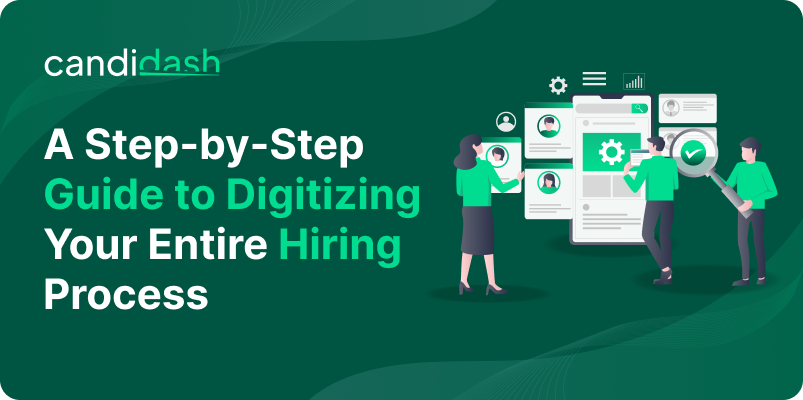
A Step-by-Step Guide to Digitizing Your Entire Hiring Process
In today’s ultra-competitive job landscape, speed, efficiency, and a smooth candidate experience aren’t just perks. They’re must-haves. Businesses that still rely on manual hiring workflows are losing out on top talent and productivity alike. The shift to a digital hiring process isn’t about using tools for the sake of it. It’s about building a strategic, agile, and data-driven approach to recruitment that scales.
This digital recruitment transformation guide breaks down each step to help you attract, engage, and hire better talent, faster. Whether you’re a small HR squad or a global recruitment team, these steps can future-proof your process and boost your hiring game.
Step 1: Analyze Your Current Recruitment Workflow
Before adding any new tools, take a beat to examine what you’re already working with. This is where real digital recruitment transformation starts — not with flashy software, but with clarity.
Ask yourself and your team:
- Which tasks are still manual, like printing resumes or filling out forms?
- Where does the process slow down? Is it waiting for approvals, feedback, or scheduling?
- How long does it take for a qualified candidate to go from application to offer letter?
- Are recruiters jumping between spreadsheets, emails, and different logins just to move one candidate forward?
These friction points are your signal flares — they show exactly where digitization will deliver the most impact. If you’re still unsure where the bottlenecks are, check out the signs you need to upgrade your recruitment process to spot what might be holding your team back.
Here’s a practical tip:
Host a whiteboard or screen-share session with your hiring team. Walk through a recent hire’s journey step by step. Capture every tool, every manual handoff, every delay. What you’ll likely find is not just inefficiencies, but duplication and missed opportunities.
Pro Tip:
Use workflow mapping tools like Lucidchart, Miro, or even Notion databases to visualize this clearly. This makes it easier to spot redundant steps, broken loops, and communication gaps that digital tools can solve instantly.
Step 2: Define Clear Recruitment Goals
- Reduce time-to-hire and improve pipeline velocity.
- Enhance candidate quality and fit.
- Lower cost-per-hire.
- Improve transparency across hiring teams.
- Strengthen employer branding and candidate engagement.
- Scale recruitment operations without increasing headcount.
Make sure these goals connect back to broader HR and business KPIs. This clarity keeps your recruitment automation steps focused and measurable.
Step 3: Choose a Centralized Digital Recruitment Platform
If you want to digitize your hiring process effectively, the first tool you lock in should be your all-in-one command center — a platform that centralizes everything from job postings to offer letters. Without this foundation, adding more tools only creates clutter.
Think of it as your recruitment HQ, where the entire team can collaborate, track, and manage every candidate in one seamless flow.
Here’s what a strong digital recruitment platform must offer:
- Applicant Tracking System (ATS): A modern applicant tracking system handles job posting, application intake, resume screening, interview stages, and offer management in a structured pipeline.
- Candidate Relationship Management (CRM): Keeps talent warm by organizing candidate profiles, past interactions, sourcing tags, and nurture campaigns — great for re-engaging silver medalists or passive leads.
- Automated workflows: Enables hands-free processes like scheduling interviews, nudging stakeholders for feedback, and sending follow-ups to candidates.
- Smart sourcing and matching: Uses filters, custom scoring, or predictive tech to match roles with the most qualified candidates in your pipeline or database.
- Compliance and audit tools: Built-in GDPR support, secure data handling, and configurable access controls keep your hiring legally sound and future-proof.
Why it matters:
Without a centralized system, recruiters waste time toggling between inboxes, spreadsheets, calendars, and messaging apps. Mistakes happen. Candidates slip through the cracks. And hiring managers feel like they’re chasing updates instead of making decisions.
Candidash, Dualoo, and Stafiz are examples of platforms that bring all the essentials under one roof. These tools support deep integration with your broader tech ecosystem — think payroll, onboarding, HRIS, assessments, and background checks.
Ready to upgrade your recruitment process?
Step 4: Automate Time-Consuming Tasks
Start with:
- Resume parsing to auto-create candidate profiles.
- Smart scheduling with calendar integrations or chatbots.
- Automated emails or texts for interview invites, reminders, and rejections.
- Triggered background checks or skill assessments.
Real results:
Teams using automation report 40% faster hiring and 60% fewer candidate drop-offs.
Pro Tip:
Start small. Automate one workflow (like interview reminders) and scale from there. It’s low lift, high impact.
Step 5: Embrace AI and Smart Matching
- Automatically score and rank applicants based on role fit.
- Analyze resumes beyond keywords — considering experience, job titles, tenure, etc.
- Match passive candidates to new roles based on skill patterns.
- Suggest similar roles to candidates when their first application is not a match.
Step 6: Go Paperless — Digital Contracts, Signatures & Documentation
- E-signatures for offer letters, NDAs, and contracts.
- Digital document storage for candidate records, ID verification, and compliance documentation.
- Automated onboarding workflows with task lists, welcome messages, and first-day prep.
Step 7: Improve Communication with Omnichannel Messaging
A digitized recruitment process must support real-time, multi-channel communication to cater to candidate preferences. Top channels include:
- Personalized email sequences with updates and next steps.
- SMS alerts for time-sensitive updates (interviews, offers).
- WhatsApp or chatbot messaging for FAQs and quick follow-ups.
Ready to upgrade your recruitment process?
Step 8: Track KPIs and Optimize Continuously
Key KPIs to monitor : Time-to-hire and time-in-stage – Conversion rates (view to apply, apply to interview, offer to hire) – Drop-off points in the funnel – Candidate Net Promoter Score (NPS) – Hiring manager satisfaction score.
With real-time dashboards, you can test changes (e.g., automated reminders or faster interview loops) and immediately see the impact.
Step 9: Ensure Compliance and Data Security
When digitizing recruitment, protecting sensitive candidate and employer data is non-negotiable. Ensure your tech stack includes:
- Role-based access controls.
- Data encryption at rest and in transit.
- Regular security patches and platform audits.
- GDPR and regional compliance support.
Step 10: Train Your Team and Foster Digital Adoption
- Offer onboarding training and refresher sessions for all users.
- Build documentation and how-to videos for self-guided learning.
- Assign a digital hiring champion or HR tech lead.
- Set platform adoption goals and review them quarterly.
Step 11: Build a Candidate-Centric Experience
Digitization isn’t just about internal efficiency — it also enhances the candidate journey. Use your tools to: – Make it easy to apply from any device – Allow candidates to track their status in real-time – Personalize communication and interview prep – Offer virtual interview options and asynchronous assessments – Collect post-interview feedback to improve experience
Step 12: Continuously Innovate and Integrate
Once your hiring process is digitized, look for continuous improvement through new integrations and automation layers:
- Integrate with talent assessment tools, payroll systems, and onboarding platforms.
- Use chatbots to guide applicants and answer FAQs.
- Add predictive analytics for workforce planning and diversity tracking.
- Consider AI-powered interview intelligence tools for deeper candidate evaluation.
Common Challenges in Going Digital with Hiring
Resistance from recruiters:
People are used to what works. Ease the transition by involving them in the platform selection process and offering hands-on training.
Tool overload:
Too many systems can overwhelm users. Streamline with platforms that integrate ATS, CRM, scheduling, and messaging in one place.
Data chaos:
When data is scattered or outdated, automation won’t help. Clean up your existing candidate database and sync your systems before rollout.
Short-term thinking:
Digital transformation is a journey. Think long-term when setting budgets and evaluating ROI.
FAQs: How to Digitize Recruitment Without the Headache
Q1: What are the first steps in digitizing a hiring process?
Start by analyzing your existing workflow, identifying manual bottlenecks, and setting clear recruitment goals aligned with business needs.
Q2: How does recruitment automation improve hiring?
It reduces admin work, accelerates candidate engagement, and improves pipeline visibility, leading to faster and higher-quality hires.
Q3: Is AI reliable for hiring decisions?
AI helps shortlist and rank candidates based on skills and experience. However, final decisions should always include human evaluation for context and culture fit.
Q4: What tools help with digital hiring?
Modern recruitment platforms like Candidash offer ATS, CRM, scheduling, automation, analytics, and integration capabilities — all in one place.
Q5: How can companies ensure data security while digitizing hiring?
Use platforms with role-based access, encryption, GDPR/IT Rules compliance, and regular audit systems to protect candidate information.
Final Thoughts: The Future of Hiring is Digital
Digitizing your hiring process is more than just an upgrade — it’s a strategic investment that sets your organization up for future growth. From automation and AI to compliance, analytics, and user experience — the advantages are undeniable:
- Accelerated hiring cycles.
- Better-fit hires with less bias.
- Stronger candidate engagement.
- Higher recruiter productivity.
- Reduced legal and compliance risk.
Whether you’re a startup scaling fast or an enterprise with complex workflows, a digital-first recruitment system gives you the tools to compete and win in the modern talent market.
Ready to simplify and scale your hiring process?
Book your free demo with Candidash and see what effortless recruitment can look like in real life
Still have questions before going digital? Don’t hesitate to connect with our team for personalized guidance on your hiring transformation.
Ready to upgrade your recruitment process?
Ready to Get Started?
Get our 14-day free trial to explore the features —the fastest approach in enterprise grade software implementation across recruitment solutions